Meditation
The Glass Bead GameMeditation is a disciplined inward attention that turns learning from the accumulation of ideas toward the experience of their form and meaning. In the life of Joseph Knecht, it first appears as the Music Master’s practical instruction in listening inwardly to music; in the Glass Bead Game, it becomes a corrective to virtuosity and a defining demand on players. The practice links private concentration, Castalian education, and ceremonial life, while leaving open a tension between spiritual experience and the religious institutions from which the Game borrows its language and forms.
A Practice Taught Through Music
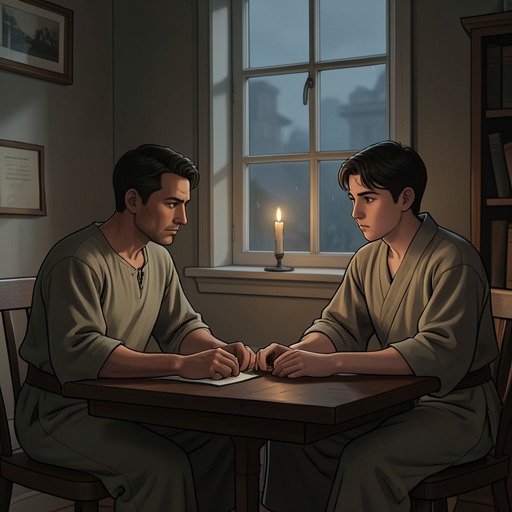
At Monteport, the Music Master tells Knecht that he will soon encounter the Glass Bead Game, but that learning to meditate matters more than anything else. He wants the boy to learn the practice as thoroughly as music, and arranges three daily lessons, each an hour long, devoted to meditating on music. The instruction is deliberately embodied and unhurried: Knecht is given milk so hunger and thirst will not distract him, and is told to drink slowly and remain silent.
The Music Master plays a theme with variations and asks Knecht to imagine the musical progression as a dance: steps balancing around an axis of symmetry. Knecht is to concentrate on the figure made by those movements. The Master repeats the music, reflects on it in silence, plays it again, then sits still with his hands on his knees and the music continuing inwardly. Knecht tries to follow the pattern as if reading the curved path of a bird’s flight. His attention falters; he loses the figure and must begin again. The exercise is not a demand to force an answer, but a return to attentive perception.
When the Master comes back, he finds Knecht sitting quietly, no longer tired. Knecht says the music had vanished and changed while the exercise was happening. The Master tells him to let it reverberate inside him, and suggests that he draw the figure he had perceived. In the guest cell, Knecht sketches a line with rhythmic offshoots, like leaves on a twig; then, dissatisfied, he curves it into a circle with radiating branches, like a garland. The exercise has carried music across the boundary between hearing and image: it is not simply remembered as sound but apprehended as a pattern that can be contemplated anew.
The Music Master’s Example
The lasting force of this first instruction comes less from a specialized technique than from the teacher’s presence. Knecht later understands that his subsequent meditation teachers gave more exact guidance, checked his results more closely, and corrected him more often. The Music Master, confident in his influence over the boy, mostly sets themes and demonstrates the way by example. His teaching is inseparable from what Knecht sees in him: an old, overworked man who can sink inward with half-closed eyes and emerge tranquil, vigorous, cheerful, and friendly.
That renewal gives Knecht a persuasive model for moving from restlessness to peace. The lesson is not that inwardness withdraws a person from the work of the day. During the same visit, the Music Master leaves to deal with a gifted but vain student in the conducting course, a task requiring both solicitude and authority. He returns to find Knecht still meditating, then shares supper with him and invites him to observe the course the next morning. Meditation is thus shown beside ordinary responsibilities and judgments: it is a practice of renewal within a life of service, not an escape from it.
The teacher’s personal attention also shapes the lesson’s meaning. He has made time for Knecht despite being exhausted and overburdened, and has taken care that the boy’s companion will not feel merely like an unwanted hanger-on. Knecht’s brief stay includes three meditation lessons, attendance at the conducting course, and informal conversations. The narrator presents the invitation itself as important: a summons from one of the twelve Masters is more than private kindness, and marks a further stage in Knecht’s vocation. The experience makes meditation both a practice and an encounter with the standards embodied by a teacher.
Meditation and the Glass Bead Game
The Game’s history makes contemplation an institutional principle. In its earlier form, a game arranged and contrasted concentrated ideas from many fields, offering a rapid passage through the realms of the mind. Such virtuosity could reward players with extraordinary memories but little beyond memory; displays of rapid recall confused and overwhelmed other participants. In response, the Game increasingly restricted these performances and made contemplation essential. After each symbol introduced by the director, players were expected to meditate silently and formally upon it. For audiences, this contemplative element eventually became the principal thing.
The change marks a shift in what counts as understanding. Players had once been expected to follow sequences of ideas with alertness, trained memory, and comprehension. The later demand is for a deeper, more spiritual approach. The Game’s techniques still combine disciplines, but their purpose is no longer exhausted by intellectual agility: meditation asks the player to dwell with a symbol rather than merely move quickly through it. The practice checks a form of mastery that can dazzle others while remaining inwardly shallow.
This discipline belongs to the larger development of the Glass Bead Game into a universal language. Its themes and symbols can link an astronomical configuration, a Bach fugue, a philosophical sentence, or a passage from the Upanishads; musical and mathematical rules give the Game an organizing form. Meditation is what prevents that capacity for synthesis from being only an elaborate arrangement of references. The contemplative pause makes the player’s relation to a symbol part of the Game itself, so the work aspires not merely to connect knowledge but to transform attention.
A Secular Ritual and Its Religious Tension
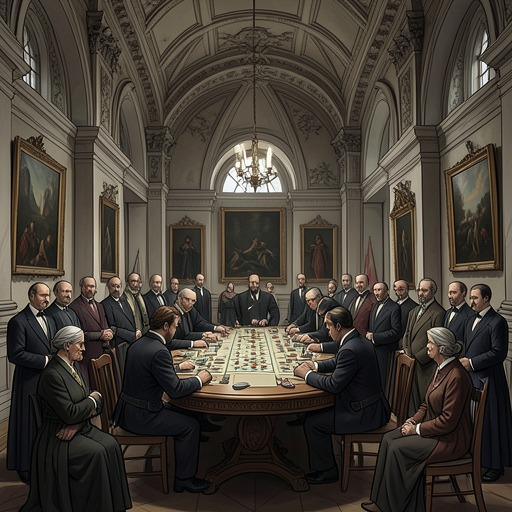
The Game’s contemplative practice draws on habits associated with the educational system and the League of Journeyers to the East, and accompanies the Game’s gradual transformation from private exercise into public ceremony. Public Games are led by senior Masters under the country’s Magister, while invited guests and audiences follow the proceedings. Some Games last days or weeks; players and guests submit to an ascetic schedule that even regulates sleep. Their absorption is compared to the disciplined penitence of the exercises of St. Ignatius Loyola. Meditation therefore helps give the public Game a ritual character: individual attention is organized into a shared ceremonial event.
Christian theology has also entered the Game’s symbolic language. A principle of the Creed, a biblical passage, a Church Father’s phrase, or words from the Latin Mass can be treated within it alongside a geometrical axiom or a melody by Mozart. For genuine players, the Game can approach worship, though it deliberately develops no theology of its own. This is a significant qualification: contemplation lends the practice religious seriousness, but does not settle whether a secular intellectual order can provide the foundation of religion.
That question becomes concrete in Knecht’s exchanges with Father Jacobus. The Benedictine scholar initially regards Castalia’s Order as an imitation of Christian models without religion, God, or Church. Knecht gives Jacobus an introduction to Castalia and the Game, while Jacobus teaches Knecht history and makes him reconsider Castalia’s past in relation to the history of nations. Jacobus’s distrust does not wholly disappear, but his understanding of the Game deepens; he eventually senses that it holds what might be called the Order’s faith or religion. Their work helps bring about benevolent neutrality and scholarly exchange between Rome and Castalia. Meditation and the Game thus stand at the point of contact between spiritual practice and institutional religion: they invite religious interpretation without erasing the disagreement over what makes such practice sacred.
Contemplation, Music, and Ethical Meaning
Knecht’s own account of classical music clarifies why meditation on music can serve as a model for the Game. He describes music as a cultural gesture that gathers a morality into form: an affirmation of human destiny, courage, and cheerful serenity in the face of tragedy and blind chance. For him, the Game should allow that same note to sound in its play and in the lives and sufferings of its players. Meditation on music is consequently more than an exercise in recognizing structure. It trains attention on a form whose order carries an attitude toward life.
The annual solemn Game offers a public counterpart to the inward lessons of Monteport. Its ceremonial performance brings together the sometimes competing disciplines of Castalia and recalls the unity that embraces their variety. For believers it has the force of consecration; for unbelievers it can serve as a substitute for religion, and for both it offers a shared experience of beauty. The movement from Knecht’s solitary listening to the public ceremony does not make private practice and collective ritual identical. Rather, it shows how disciplined attention can be carried outward: meditation begins as a boy’s effort to follow a musical figure, and becomes part of an institution’s attempt to hold intellectual plurality within a common spiritual form.